Robert's Liner Notes

Are My Singers Real--Or AI? 

I use an AI choir to perform demos of my a cappella music.

Well, sort of.

You may be familiar with virtual instruments—software plug-ins used to create music in digital audio workstations. They can produce remarkably realistic pianos, drums, strings, brass, woodwinds, and much more.

A composer can control the melody, rhythm, dynamics, articulation, and countless other details to create just the right sound. These virtual instruments have become increasingly common in professional music production.

Now, we also have virtual singers—and they’re sounding more realistic every year. Some are even convincing enough to sing background vocals on a professional release alongside a human soloist.

So, how do software companies make these singers sound so real?

Does AI create the voices out of thin air based on what it knows about human singing? Or does it use thousands of voices gathered from across the internet?

No, neither one—at least not in the case of the company I use, Dreamtonics.

Dreamtonics hires singers to record extensive material in different styles and languages. The singers are paid, and their performances are legally licensed for use in the software.

Recently, Dreamtonics released its Choir Voices, which I now use for my a cappella demos. They don’t sound quite as natural as a live choir, but they come remarkably close—certainly close enough to create effective demos.

I spent about twenty years as a church choral director, so I know how difficult it can be to find great music that suits a particular choir. Directors can spend countless hours searching, which makes good demos especially valuable.

As an independent composer who offers his music for free, however, I can’t afford to hire a choir to record every piece.

For my purposes, a virtual choir is an ideal solution. I can direct it much as I would a live ensemble:

“Sopranos, use less vibrato here.”

“Choir, emphasize these words.”

“Basses, give this phrase a stronger attack.”

The singers may be virtual, but the musical decisions are very real.

Watch this short video that contains a clip from one of my a cappella demos and let me know: How close does it sound to a live choir?

Note: I am not paid by or affiliated with Dreamtonics. My only relationship with the company is as a customer and user of its products.
How Do You Create an SATB a cappella Piece from a Simple Song? 

How do you turn a song with just a melody, lyrics, and chords into an SATB a cappella piece? For me, it’s a puzzle—and one of the most enjoyable parts of composing. You already have the song. Now you have to make it work with nothing but soprano, alto, tenor, and bass voices. 

Those voices have to do everything: carry the melody, establish the harmony, provide rhythmic movement, and bring the words to life.

Read more in the YouTube description for this video:

Where Do My Songs Come From? 

Hopefully, they’re inspired by God, because I don’t know where else they could be coming from.

Sure, I am a classically trained musician, as they say, with a Bachelor of Music degree and twenty hours of graduate study. But that’s not enough to make you a good composer—believe me.

I learned guitar as a teenager by playing songs by the Beatles, the Beach Boys, and other bands. I also started trying to write my own love songs, but the early ones were pretty bad. Over the years, I improved, and the formal music training was helpful. But really, the most important element was experience. Once you have a decent musical foundation, you just have to keep writing until you get better.

But that only gets you to the point where you can write a good song. When it comes to writing music that offers spiritual inspiration, you first need to get that inspiration from the Bible. From God.

After I accepted the call to become a music minister, I began thinking about writing sacred music. But I didn’t know if I could actually do it. All the music we had sung in youth choir was accompanied by piano, and even though I had taken some piano lessons as a teenager, I was terrible at it.

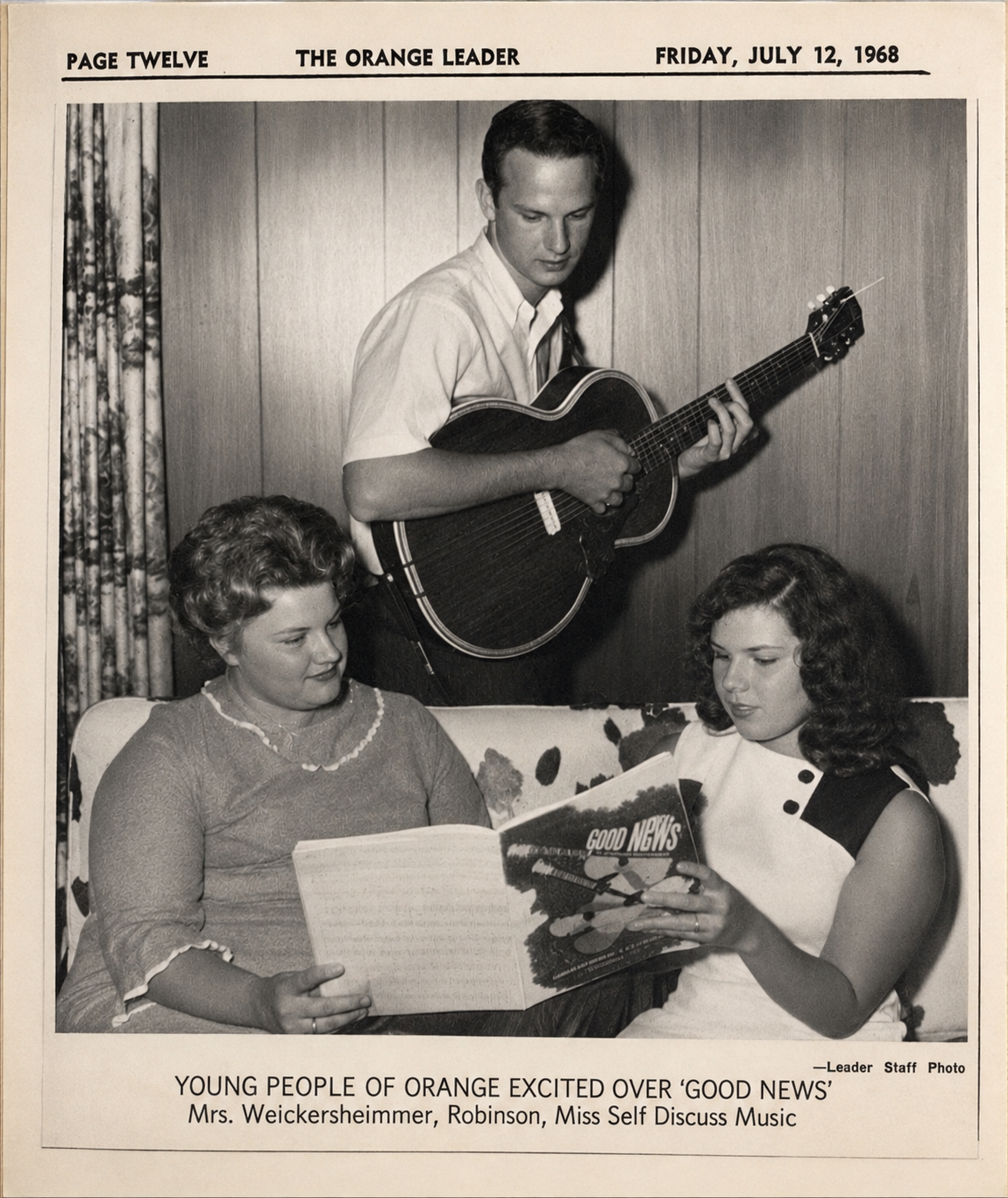
A major turning point came during the summer of 1968, just as I was about to enter college. We learned that a new, “first of its kind” piece of music was going to be performed by the young people from our church and other churches in the area. It was a youth musical called Good News—A Christian Folk-Musical, and it was to be accompanied by guitars and drums.

I was ready to whip out my guitar for that.

I was very excited. After several joint rehearsals, we performed Good News at First Baptist Church in Orange, Texas. I learned later that many other performances were happening around the country at about the same time. I’m not sure how many kids were in our combined choir—probably somewhere between 100 and 150—but it was a huge success!

After that, I realized I could write songs on my guitar and actually perform them in church with a guitar—although it took a while for some congregations to get comfortable with that. One time in 1975, at a church where I was serving as part-time music minister, the pastor said to me, “What are you—a dignified hippie?”

And he wasn’t trying to be funny.

I can do some things at the piano, and I’ve written many piano accompaniments for choral music. But the truth is, I still do my best songwriting while playing guitar—just as a piano player would probably do their best songwriting sitting at the piano. With a guitar in my hands, I’m able to let my imagination run free because I don’t have to concentrate on the instrument.

Even my a cappella compositions start on guitar, with a melody and lyrics over chords. The melody and chords usually come easily for me. It’s the lyrics that are the real work.

I usually start with a question. For example: How can people not believe in God when they know about things that only an omnipotent deity could do? Scientists tell us that the observable universe contains an estimated two trillion galaxies—and that’s just the observable universe. There are also some eight billion people on planet Earth, yet every single one has unique DNA. How can these things be true without an almighty Creator?

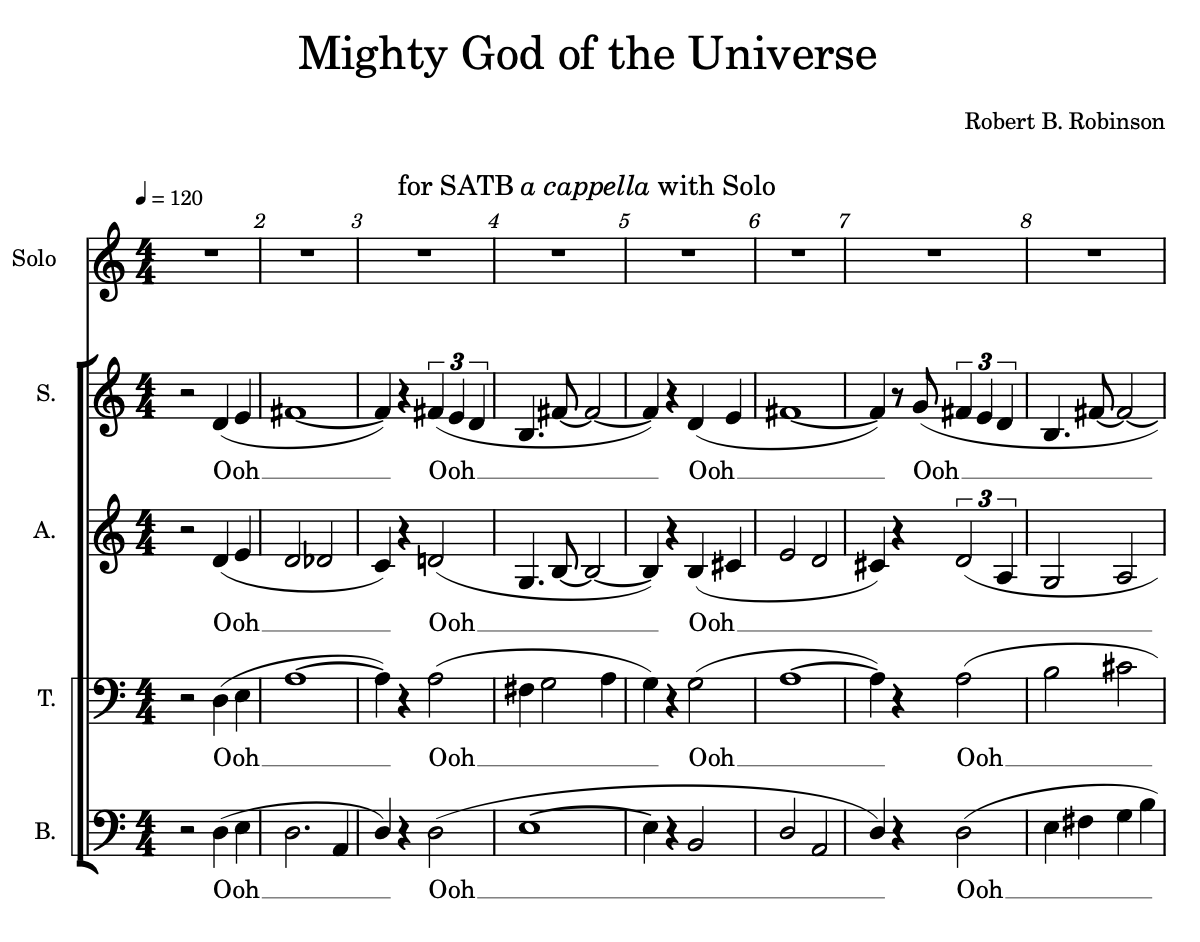
That question got me going, and I ended up writing “Mighty God of the Universe.”

Of course, creating rhyming lyrics that are also singable is tricky, but it’s something I really enjoy. Then there’s the challenge of turning the song into an a cappella piece. It’s a fun puzzle because I want each of the SATB parts to be interesting. I want every part to have its own bits of beautiful melody.

So I combine a strong melody with interesting rhythms, harmony, and dissonance, working within the strengths and vocal range of each section to produce a dramatic result.

That’s how my songs come together. The musical training helps. Experience helps. The guitar helps. But the inspiration? I believe that comes from God.

Free New a cappella Music for Church Choirs 

I started composing music for church choirs in 1972. Yes, I’m getting old. I had been working as part-time music minister a couple of years before that, and was crazy enough to think I could write music for my choir. At that point I’d had one year of music theory in high school and one year in college.

A few years later I finished my music degree in vocal performance and served as full-time music minister until the late 1980’s. During that time I also ran a small church music publishing company for six years. Later, I did graduate studies in music composition and education.

Most of the music I composed was for SATB with piano accompaniment, and sometimes with additional instrumentation, including strings, brass, woodwinds and percussion. But I also wrote a few a cappella pieces, which I really loved doing.

I have just released my first new a cappella composition on this website (Mighty God of the Universe) and I’m very exited about it. I’ll be releasing more a cappella titles in the coming weeks and months.

And I am offering everything you need for your choir for free. You can download all of the PDF and MP3 files and distribute them however you like. You can print them or use them in their digital form. If you make an audio or video recording of the music you can share those recordings, including online for no charge. I am the sole copyright owner, and I give you permission to do this.

It is such a blessing in these days of technology to be able to read the music from a phone or tablet—avoiding the cost of printing it. And because I am offering the soprano, alto, tenor and bass parts as individual PDF’s, as well as the individual MP3’s, it should make it easier for singers to learn their parts.

Also included for free: the full score, the piano reduction (for rehearsal only), and the full demo MP3.

I hope you will use this music in your worship, and if you do, please send me a note via the Contact form. I’d love to know about it.

© 2025 Robert B. Robinson. Some rights reserved. This work is licensed under CC BY 4.0

Can you imagine a 7-Dimensional Heaven? 

This 26-second video short includes an excerpt from my song, "Supernatural Story." 

Part of the lyrics say: "You can't conceive of a 3D Heaven? Instead of 3D, imagine 7." 

Imagine a 7D Heaven? What in the world does that mean? 

Hundreds of times in the Bible the number 7 signifies completion or perfection. So my thinking was that a 7-Dimensional Heaven is a way of describing an absolutely perfect place that we can't begin to comprehend. 

And I used a rainbow in this video because a rainbow is made up of exactly 7 colors. It too, is perfect.

Watch the full-length lyrics video of the song: 

(Or watch the SATB a cappella version)

The Day I Died 

On September 7, 2023 I died. 

I was suddenly on the floor with no heartbeat, no breathing. 

Dead.

I had suffered a heart attack known as a sudden cardiac arrest. I was sitting across from my wife at a restaurant when I got very dizzy. I felt my neck, checking my pulse, thinking I might be in AFIB, expecting my heart to be racing. Instead, I felt nothing. I mumbled to Lynda, “My heart’s not beating,” and passed out.

Several people got up from their meals and rushed over to help. The were gathered around me and Lynda couldn’t even see what they were doing. But obviously, someone gave me CPR—I still don’t know who it was, but I am incredibly grateful.

The paramedics arrived, took me to the ambulance, and worked on me for fifteen minutes. Then we were off to the emergency room. They rushed me in, and five or six people quickly prepared me to go to the Cath Lab while (it seemed like) another ten stood and watched. Once I was in the Cath Lab, the cardiac surgeon evaluated my heart. It was beating, but the rhythm was out of control (Torsades de pointes). 

The cardiologist quickly discovered that I had a 99% blockage in the LAD artery (the infamous “widow maker” blockage) and an 80% blockage in another artery. He installed a stent in the LAD, and the second stent was installed four days later. Before this, I already had stents in two arteries, (from 2010 and 2015), but they were stable.

The next day, the cardiologist told me, “Mr. Robinson, you are a very lucky man. Out of 100 people that this happens to, 93 are either dead or brain dead.” I understood what he meant. If I had been in bed sleeping or on a plane or driving a car when it happened I would have been a goner.

Amazingly, I suffered no permanent damage to my heart. This was a bit shocking, since this is not the norm.

But I don’t believe I was simply “lucky.” I tried to believe that at first, because otherwise I would have to accept that God had stepped in and spared my life for some reason. But for what reason? Was I supposed to carry out some special Godly mission?

I had no idea. So I put that thought out of my mind and just went on with life. But eventually I began to wonder if I was meant to go back to my Christian songwriting roots. Back in the 1970’s and 80’s I had served as part-time and full-time music minister at more than half-a-dozen churches, and composed 13 choir musicals.

But what was the point? I knew I could write some praise and worship music (better music that I had written before), but who would care? Who would actually use it?

My strong feeling was to go ahead with it anyway. And so, I am.

Did God spare my life so I could do this? I still can’t say for sure, but, again—I’m going ahead with it anyway.

I guess that’s faith. Or at least some form of faith.